
Reader-safe reference
The Prime Fallacy Glossary
A spoiler-light guide to the people, systems, cities, game language, and organizations that shape Book 1 and the wider Prime Fallacy universe.
How To Use This Glossary
Use this page as a reader-safe map for the major terms that appear around Book 1, Earth-Side systems, Dens & Wyverns, and genre language. Category chips jump to the main groups, while related paths point toward deeper world pages when you want more context.
Core Story Terms
Start here for the terms that orient the series, the first book, and its major systems without stepping into late-book answers.
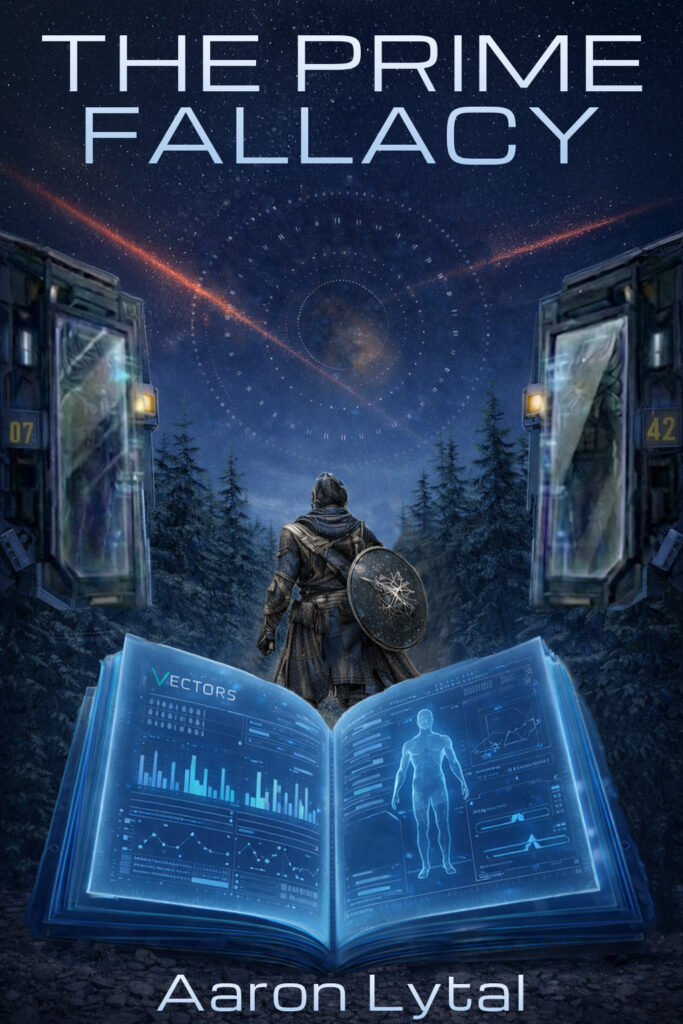
The Prime Fallacy
Book 1 and the wider science-fantasy LitRPG/GameLit universe.
Book 1
the first published entry point for the series.
Roland Kurt
the central protagonist and a solo-oriented Dens & Wyverns player.
Hope's Point
the settlement that becomes an important anchor inside Book 1.
Codex Vitae
a character-sheet, journal, and system-interface concept inside Dens & Wyverns.
VECTORS
the seven-stat capability system used in the world.
Earth-Side
Earth-Side terms cover the future-Earth context around Book 1: cities, infrastructure, public systems, and reader-safe history.
Earth-Side
the future-Earth setting around Book 1.
Gulf City
a major future-Earth city shaped by climate adaptation, dense infrastructure, and civic systems.
ARC Stasis Towers
the physical and civic infrastructure associated with long stasis cycles.
Planetary Logistics
the civilization-scale coordination systems that keep Earth operating.
Timeline
the broader chronology behind Earth-Side systems and Book 1 context.
Notable Figures
the page path for important people and public-facing figures in the setting.
Shift Systems
These terms describe the public-facing stasis system, its interfaces, and the civic language built around participation.
The Shift Program
Earth-Side's decade-cycle stasis and civic contribution system.
Shift
shorthand for the stasis cycle and the social structure around it.
Stasis Cycle
a period in which people enter suspension as part of the Shift.
Neural Lease
the broad idea that human neural processing is leased to the network during stasis.
Tardigrade Suspension Protocol
the biostasis method behind long-duration suspension.
Civic Neural Interface (CNI)
the subdermal authenticator and routing interface.
Prime
the central AI system managing large-scale coordination and routing.
Hibernation Hub
a digital interstitial used during Shift routing.
Virtual Shards
cognitive engagement environments used during long stasis cycles.
Civic Contribution
the public-duty framing around Shift participation.
Dens & Wyverns
Dens & Wyverns is the in-universe game and lore route. The site also has a separate real-world idle game page, so the glossary keeps those paths distinct.
Dens & Wyverns
the in-universe fantasy game and lore path connected to Book 1.
Idle Game
the real-world companion project on the site, separate from Dens & Wyverns.
NPC
a non-player character, with Book 1 complicating what that means without explaining late reveals here.
Quest
a game objective or task that can move characters, factions, or story pressure forward.
Instance
an isolated copy of a dungeon, zone, or encounter.
Respawn
a return-after-death game concept that Book 1 treats with caution.
Founder Mechanics
settlement-building mechanics connected to Hope's Point.
Obelisk
a settlement structure tied to town functions and system behavior.
Game Terms
These genre and mechanics terms help place Book 1 for LitRPG, GameLit, progression fantasy, and RPG readers.
LitRPG
fiction where RPG mechanics such as stats, skills, classes, or system messages are part of the story.
GameLit
fiction shaped by game logic, virtual worlds, or game structures, whether or not stats are explicit.
Progression Fantasy
fiction centered on measurable growth, training, power advancement, or increasing capability.
Stats
numerical or named measures of character capability.
Skills
learned or unlocked abilities.
Classes
role, build, or archetype structures used in many RPG systems.
Buffs and Debuffs
temporary positive and negative effects.
Cooldowns
limits on how often an ability can be used.
HUD
a heads-up display or interface layer.
Organizations
These organizations and status structures shape public systems, oversight, resistance pressure, and opportunity inside the Shift-era society.
Artificial Artifice (AA)
the corporation behind major AI, stasis, and Shift infrastructure.
Human Control Dynamics (HCD)
the human-oversight organization connected to automated systems.
Stitch Local 414
a public-facing labor or resistance-related group named in Shift Program context.
Linebreakers
a resistance-related group named in Shift Program context.
Ladder System
a civic status and opportunity structure tied to the Shift-era society.
Related Paths
Use these routes when a glossary term needs more context than a short definition can provide.
Start with Book 1
The glossary is a map. Book 1 is where the systems, terms, choices, and consequences begin to move together.