
The Prime Fallacy: A Science-Fantasy GameLit / Soft LitRPG Universe
The Prime Fallacy is a science-fantasy GameLit / soft LitRPG universe about survival, control, AI infrastructure, neural leases, and game systems with real consequences.
For readers who enjoy RPG progression, game mechanics, deep worldbuilding, and stories that ask whether the end can ever justify the means, The Prime Fallacy begins with Book 1.
Available on AmazonFree with Kindle UnlimitedEbook & Paperback
The Book at a Glance
- Series: Book 1 of a planned trilogy, with room for the universe to expand beyond the core arc.
- Genre: Science fantasy · GameLit / soft LitRPG · dystopian, with cosmic-horror threads.
- Story tension: Future Earth is already strained by scarcity, AI dependence, and neural leases, while Book 1 reveals a deeper threat known as the Black Maw.
- Length: ~354 pages (about 127,000 words)
- Reading age: 12+ — fantasy and action violence, no explicit content, minimal strong language.
- Formats: Kindle ebook (free to read in Kindle Unlimited) and paperback on Amazon.
- Get it: Buy Book 1 · Read Sample Chapter · Add on Goodreads
The Universe Behind The Prime Fallacy
The Prime Fallacy is built as a science-fantasy GameLit / soft LitRPG universe, not just a fantasy game pasted onto the future. The systems inside Dens & Wyverns grow out of the world around it: AI infrastructure, neural leases, resource scarcity, virtual competition, and a culture that has learned to measure human potential in numbers.
The result is a LitRPG-style story where stats, progression, and game mechanics still matter, but they are tied to deeper questions about control, identity, and what people are willing to trade for safety.
Prime And Artificial Artifice
Artificial Artifice is the dominant global company behind much of future Earth’s infrastructure, and Prime is the AI system at its center. Prime supports daily life, powers virtual environments, monitors risk, and helps manage systems most people rely on without thinking about them. It is useful, efficient, and deeply embedded, which makes questioning it difficult.
Neural Leases
Most citizens live with neural implants installed at a young age. Through those implants, they lease a portion of their brain’s unused processing capacity back into the network. A baseline lease is effectively required to access modern systems, while higher leases can provide more credits, comfort, or opportunity. The cost is not only economic. It raises the question at the heart of the series: how much of yourself can be leased away before something human is lost?
The Shift
In public, the Shift is presented as a response to resource scarcity. As physical resources become harder to sustain, more of human life moves into managed virtual spaces: work, housing, entertainment, and social status. It is sold as practical, efficient, and necessary, but it also makes the line between protection and control harder to see.
VECTORS And Virtual Trials
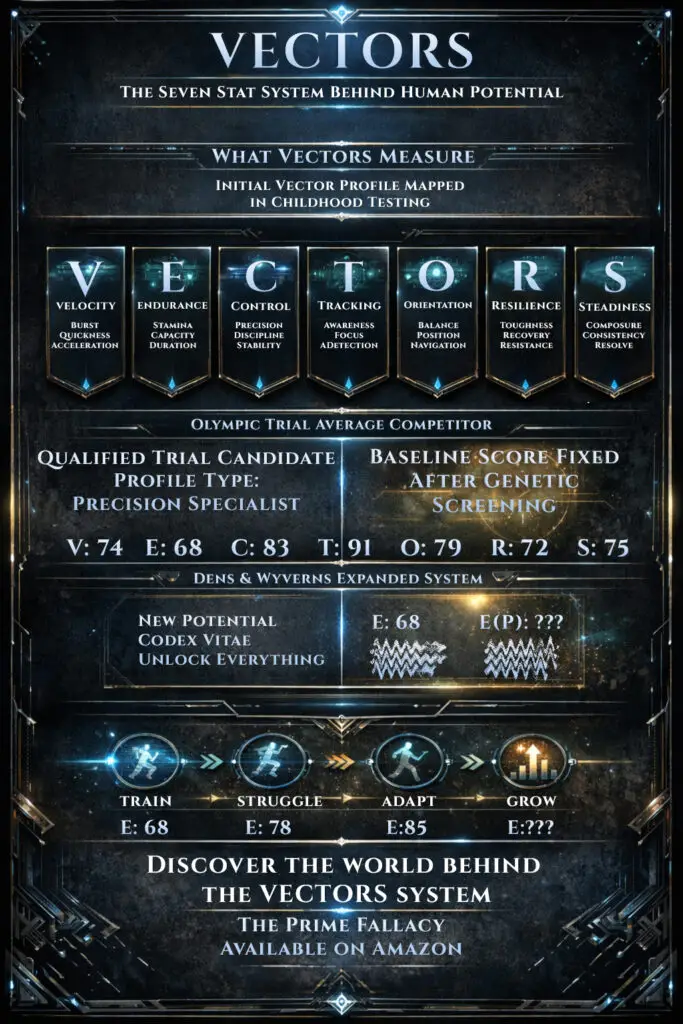
VECTORS is the seven-stat system behind human potential: Velocity, Endurance, Control, Tracking, Orientation, Resilience, and Steadiness. Children receive early scans, later scans define competitive profiles, and virtual Olympic-style trials let people compete at the peak of what their bodies are structurally capable of becoming. Before Dens & Wyverns enters the story, future Earth already understands people through stats.
Dens & Wyverns
Dens & Wyverns is an old-school fantasy MMORPG at its core: D&D-style adventuring blended with dungeon runs, raids, mythology-inspired enemies, party roles, classes, quests, and progression. It gives Roland and other players a world of builds, strategy, and fantasy escape while still reflecting the systems that shaped future Earth.
Roland Kurt: The Reader's Way In
Roland Kurt is not a chosen hero waiting for destiny. He is a tired, sharp, guarded systems worker trying to get through life inside Human Control Dynamics, where AI oversight, neural lease infrastructure, and human sign-off all blur together.
Games are the one place Roland still feels like effort, timing, and choice matter. Dens & Wyverns gives him builds to test, systems to understand, and problems he can actually solve. But as the story moves forward, Roland is forced to question the same structures he depends on: Prime, Artificial Artifice, the neural lease economy, and a world where people are increasingly measured by what they can provide to the system.
The Series
The Prime Fallacy begins with Book 1, now available on Amazon in ebook and paperback, including Kindle Unlimited. Book 2 is in progress, and Book 3 is planned as part of the core arc.
The series is being built with a clear destination in mind, but the universe has room to grow beyond the initial trilogy. Earth-Side, Dens & Wyverns, VECTORS, Prime, and the wider history of the world all leave space for future stories, deeper lore, and connected projects.
How The Prime Fallacy Took Shape
The Prime Fallacy began in 2023 during a busy season of real life. I had recently become a father, my family had moved to a new city, and I was working to establish my home design business in a new area. The book grew in the margins of that life: during quiet hours with my son, late nights, and the small pockets of time I could carve out between work, family, and starting over.
The world came first. Before the characters fully emerged, I wanted to understand how a LitRPG-style system could exist in a way that felt grounded. What kind of future would need it? What infrastructure would make it possible? What would happen if AI, virtual life, neural implants, sports, economics, and survival all started feeding into the same system?
Early versions of the book were crunchier, with heavier mechanics and more visible numbers. Over time, I softened the LitRPG elements so the story could stay accessible while still giving GameLit and LitRPG readers the systems, progression, and build logic they enjoy. VECTORS, the Codex, Prime, and Dens & Wyverns all came from that same goal: to make the game mechanics feel like they belonged to the world, not like they were added on top of it.
Why The System Had To Feel Grounded
The deeper logic of the system is part of the larger series arc, so not everything can be explained up front. But from the beginning, I wanted the numbers, stats, and progression to have a reason to exist inside the world. The result is a science-fantasy LitRPG universe where the game system is connected to future Earth’s technology, culture, and ethical compromises.
Meet Aaron Lytal
I’m Aaron Lytal, the author of The Prime Fallacy. I’m also a husband, father, small business owner, home designer, and lifelong gamer. This book grew out of all of those parts of my life.

Aaron Lytal
Games have been with me for as long as I can remember. I started with Mario on the NES, moved into JRPGs like Final Fantasy on the SNES, and later spent years with games like World of Warcraft, Magic: The Gathering, and Path of Exile. I've always been drawn to games with systems: builds, choices, tradeoffs, progression, and worlds that reward careful thinking.
My work as a home designer shaped the book in a different way. Planning a home means thinking about structure, flow, constraints, and how separate pieces fit together into something people can actually move through. That mindset carried into The Prime Fallacy. I wanted the world to feel planned, not random; organized, but still alive; big enough to explore, but built on rules that make sense.
At its heart, this series is my way of exploring questions I kept coming back to: what makes us human, what we give up for safety or convenience, and whether doing something for the greater good can still cost too much.
Why I Wrote The Prime Fallacy
I wanted to write a story that could scratch the GameLit and LitRPG itch while also asking bigger questions about AI, identity, control, and survival. The stats, systems, and game mechanics matter, but they are there to support the story of people trying to stay human inside systems that keep measuring them.
What Our Readers Are Saying
Readers have responded to The Prime Fallacy for its blend of science fiction, GameLit progression, fantasy adventure, AI tension, and deep worldbuilding.
Frequently Asked Questions
Is The Prime Fallacy a standalone or a series?
It is Book 1 of a planned trilogy. Book 1 tells a complete arc with a satisfying climax while opening a much larger story and universe.
Do I need to play video games or know LitRPG to enjoy it?
No. The story leans GameLit / soft LitRPG: the systems, stats, and progression matter, but the book is written to stay readable for fantasy and science-fiction readers who are newer to the genre.
What is LitRPG / GameLit?
LitRPG is fiction set in or around a game-like world with visible stats, levels, and systems. GameLit keeps the game-shaped world and progression but usually uses lighter numbers. For a fuller explanation, read What Is LitRPG?
Is it appropriate for younger readers?
It is aimed at roughly 12+: fantasy and action violence, no explicit content, and minimal strong language.
Is it on Kindle Unlimited?
Yes. The Prime Fallacy is free to read with Kindle Unlimited and also available as a paperback on Amazon.
Where should I start?
Start with Buy Book 1. If you want a taste of the world first, explore the World guide, Earth-Side, or Dens & Wyverns.
Start With Book 1
Enter a science-fantasy GameLit / soft LitRPG universe where AI infrastructure, neural leases, human potential, and old-school fantasy adventure collide.
Want release updates, behind-the-scenes notes, and future worldbuilding news? Join updates below after you choose your next step.
By signing up, you agree to our Terms and Conditions.