
World Guide · Earth-Side System
VECTORS: Seven Measures of Human Potential
VECTORS is the seven-stat capability system used on The Prime Fallacy’s future Earth. Early scans, later competitive profiles, and virtual trials turn human potential into a language society can measure and compare.
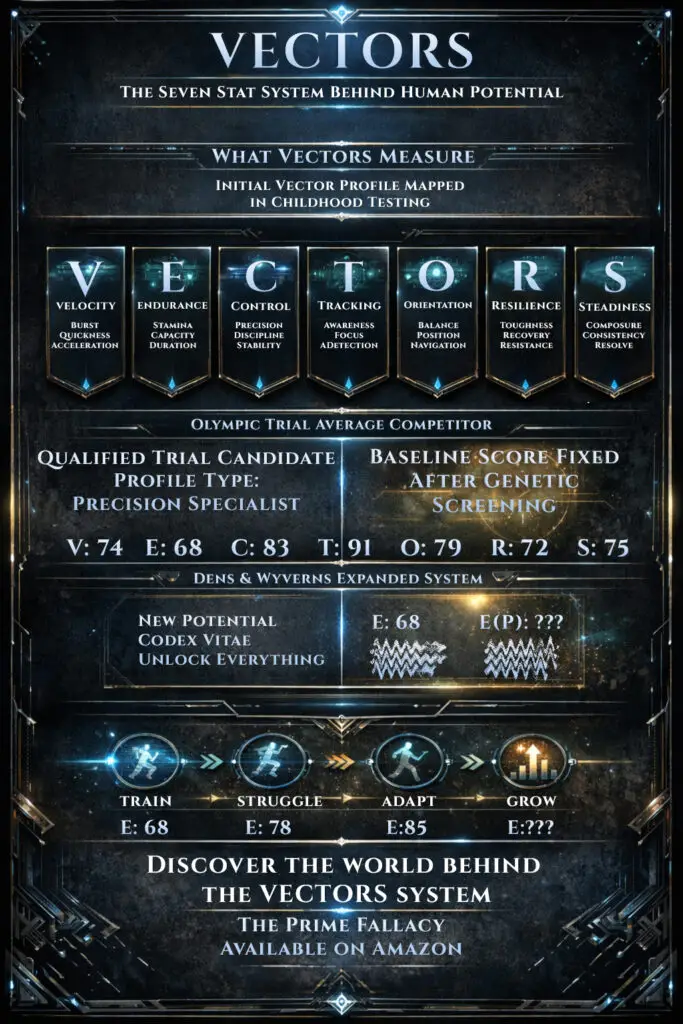
What VECTORS is
Rather than collapsing a person into one score, VECTORS separates capability into seven traits. Together, those traits describe movement, sustained effort, precision, perception, spatial awareness, recovery, and composure.
Early scans
Children receive early VECTORS scans, establishing a structured view of their developing potential.
Competitive profiles
Later scans define profiles that can be compared within competitive and trial settings.
Virtual trials
Olympic-style virtual trials let people compete at the peak of what their bodies are structurally capable of becoming.
The seven VECTORS traits
Each trait isolates a different kind of capability. The definitions below preserve the useful seven-part explanation while giving every trait a semantic place on the page.
Velocity
Measures speed, burst, and acceleration: how quickly someone can move, react, and turn intent into action.
Endurance
Measures stamina and sustained effort: how long someone can continue as strain and exhaustion build.
Control
Measures precision, coordination, and discipline: how accurately and efficiently someone can act.
Tracking
Measures perception in motion: following movement, reading patterns, and responding to a changing target or environment.
Orientation
Measures spatial awareness and positioning: understanding distance, angles, and where to be in the moment.
Resilience
Measures durability, recovery, and resistance to breakdown after impact, stress, or setbacks.
Steadiness
Measures composure, balance, and consistency under pressure: remaining reliable when conditions become unstable.
A system embedded in daily life
From scan to virtual trial
The system is not introduced as an obscure game mechanic. It is already part of future Earth’s way of describing potential, training, and public competition.
- Capability is scannedEarly testing gives people a seven-part profile rather than a single undifferentiated score.
- A competitive profile emergesLater scans give trials and competitors a shared framework for comparison.
- Potential enters the arenaVirtual trials let competitors perform at the peak of what their bodies are structurally capable of becoming.
Why VECTORS matters to Book 1
Before Dens & Wyverns enters the story, future Earth already understands people through stats. That cultural familiarity helps connect the Earth-Side setting to the stat-driven language readers encounter around Roland’s story.
Earth-Side context
VECTORS belongs to the same future-Earth landscape as managed infrastructure, public programs, and virtual competition.
A familiar stat language
Numbers and profiles are already culturally legible before fantasy-game systems become important to the narrative.
A reader-safe bridge
This overview explains the premise-level connection without detailing later changes, outcomes, or character revelations.
Follow the system into the wider world
VECTORS sits where capability, public systems, competition, and stat-driven storytelling meet. These pages provide the next layer of context.
See the system inside the story
VECTORS is one piece of a larger science-fantasy world. Book 1 is where its stat-shaped culture, Earth-Side pressure, and Dens & Wyverns begin to move together.