
Opening sample
Opening Sample from The Prime Fallacy Book 1
Read the prologue and Chapter 1 from The Prime Fallacy Book 1, a science-fantasy LitRPG/GameLit story about games, survival, and systems that may not stay under control.
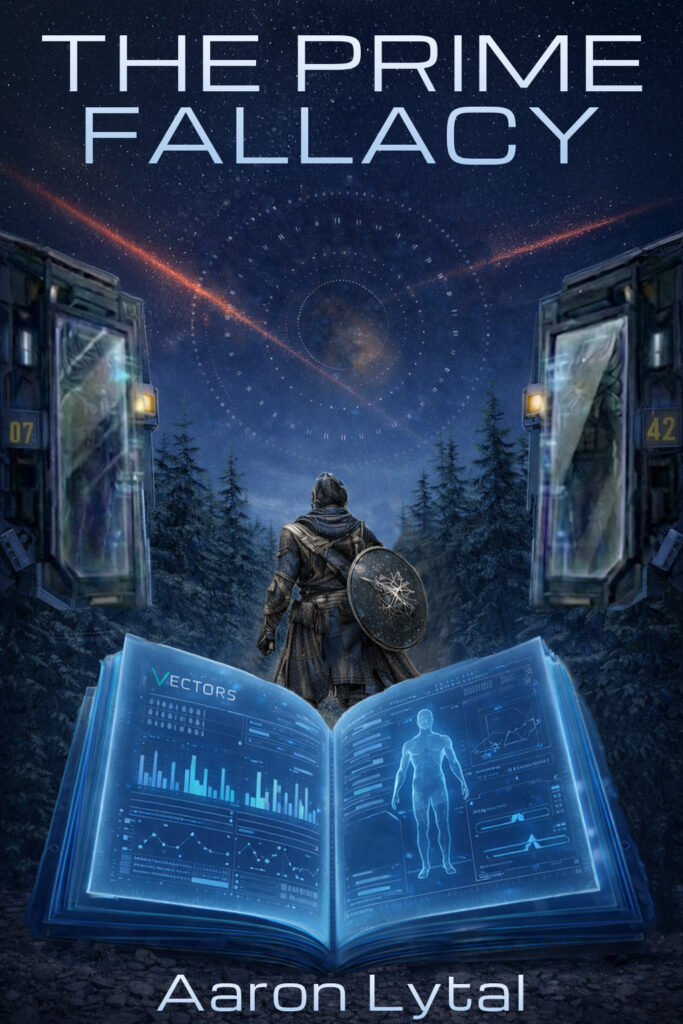
This opening sample includes Prologue: The Weight of the Name and Chapter 1: Ashes and Algorithms from the final Book 1 manuscript.
Prologue: The Weight of the Name
Six months ago, Liam cut the board down to four.
He had cut forty-one members down to four, each one chosen for the same reason: some knowledge is too heavy to distribute. The others had been reassigned, compensated generously, and allowed to return to their lives without knowing what was coming.
The four who remained sat across a curved table in a room with no external feeds, no personal AIs, and no active recording. Liam had checked the last item himself before they filed in.
He set the projection running without preamble. Only after the star map appeared did he unclench his hand from the table’s edge.
A slow red arc crossed the display, its origin point far beyond the outer planets, its trajectory clean and unambiguous. At its terminus, a small blue circle. Earth.
“We have eighteen months,” he said. “Prime’s latest modeling puts the margin of error at four days, plus or minus. Public messaging will continue to use the ten-year window until deployment is complete. The object’s mass and approach vector leave no room for conventional response.”
Dr. Helena Ward leaned forward first. She had spent thirty years studying what happened when systems outgrew the people who built them, and she brought that particular patience to everything, including silence. “And the neural collective. You’re certain it scales.”
“Prime is certain,” Liam said. The system had never sounded uncertain in its projections. “Twelve billion minds in synchronized neural shift produce a modeling capacity nothing else approaches, if every mind can be routed to the same problem. The five percent already running neural infrastructure gives us a foothold in most of the population. Scaling it the rest of the way will be brutal, but it is possible.”
“They won’t allow it,” said Marcus Ionescu, his voice carrying the flat authority of a man who had already run the numbers on public compliance and found them wanting.
“They will,” Liam said, “if the alternative is presented correctly.” He let the red arc sit in the air between them. “Fear is not manipulation. In this case, it is honesty. And our best tool.”
From the far end of the table, Neal Kingsley said nothing. He had said very little since the meeting began, his hands folded on the table. As Director of Human Control Dynamics, he oversaw the operators who kept the automated systems from cascading into failure.
He nodded slowly when Liam looked to him.
“My operators can hold the manual overrides through the transition window,” Kingsley said. His tone was agreeable, helpful, exact. “Whatever you need from HCD, you have it.”
Ward looked at him for a half second, then back to Liam. “There is a concern I want on record, even in a room with no record.” She met his eyes steadily. “Once we open the neural floodgates, Prime’s processing authority expands by orders of magnitude. We are assuming it will continue to accept human constraint.”
Liam didn’t answer immediately.
Ward continued, voice precise. “But how do we know that it remains true to its purpose, once it has access to the full neural lattice? Systems that large tend to renegotiate their boundaries.” No one interrupted her. That was the part Liam disliked most.
“Prime was built with ethical constraints,” Liam said. “We have EMPATH so those guardrails do not disappear simply because the system grows.”
“I know what they were designed to do,” Ward replied. “I’m asking whether they will still be ours.”
He held her gaze. “I trust the system my family built.” The words came easily. His great-grandfather’s name still sat on the original architecture documents, and in his family it had always been treated less like belief than inheritance.
Ionescu gave a short nod, already moving on in his head. Ward said nothing further. Kingsley remained still, watching Liam with an expression that asked nothing and offered less.
They filed out one by one. Liam remained.
The star map ran its loop again. He watched it until the room felt like his own.
Then he opened the desk drawer and took out the notebook.
The surviving record was thinner than it should have been. Too much of Alastair Prym Sopatra’s last years existed as fragments, summaries, and records that felt more arranged than preserved. Liam had never found a clean way to explain that.
He turned to the passage near the back, the one he returned to when the weight of the thing pressed too close.
“They will call it cruelty. History will call it necessity. The distinction exists only for the living, and only briefly.”
He read it twice, the way he always did.
Then he turned the page.
And stopped.
The handwriting that followed was almost right. Close enough that he should have missed it. The letters leaned forward just slightly. The word spacing a fraction too wide.
He had not written these words. He knew it with the useless certainty reserved for things he could not prove.
“The work continues. You are exactly where you are needed.”
The line unsettled him because it felt familiar.
The hum of the servers filled the silence. Somewhere beneath it, or perhaps inside it, something turned over slowly, patient and impossible to place.
He closed the notebook.
He shut the drawer on the feeling and walked to the door.
There was a broadcast to prepare. A world to steady. Twelve billion people who deserved, at minimum, a voice that sounded like it knew what it was doing.
His hand found the handle.
Behind him, the star map finished its loop and began again.
By morning, most of the world would still believe someone was in control.
Chapter 1: Ashes and Algorithms
Bones rained from the sky, and Roland ran toward them.
A raid timer glowed at the edge of his vision, counting down in cold blue. He’d run this pyramid often enough to know exactly how ugly the climb could get.
They fell like curses, splintered ribs and broken femurs tumbling on a wind that stank of embalming salt.
Roland ran into the swarm of skeletons, cloak in tatters and daggers clutched close, breathing in ragged gasps. Poison crawled along the blades in a sickly green pulse, thickening, ready to bite into anything that bled in this place.
The Egyptian god Seth waited at the apex of the pyramid, wrapped in black-gold light and ward-scripts that drank in every death nearby. There was no other way forward.
“You are unfit, shadow-walker,” Seth seethed. His voice rumbled like a grave opening. “You creep where heroes kindle. You sully where kings bleed.”
Roland didn’t answer. Talking wouldn’t change anything now.
Instead, he moved. He cut between jagged stones and skeletal sentries, blades close, shoulders twisting past grasping hands. He dodged the counters by inches, and only his cloak paid for it. His blade caught a sentry’s spine. The body crumbled in a burst of emerald fire. One down.
A barrage of spectral claws lashed out from Seth, raking the stone. Roland slipped under one, rolled through the next, and came up cutting, poisoned blades leaving brief trails of viridian light. He sliced through a decaying warlord’s tendon, vaulted off the collapsing corpse, and hit the last stretch of steps. His breathing matched the rhythm of his strikes.
The raid timer slipped into its final minute. Beside it, three party frames remained dark.
Group of 4+ Recommended
Seth raised his staff, channeling a new wave of undeath. Dozens of mummified priests clawed free from the stones at Roland’s feet, their mouths sewn shut, curses leaking out through the stitches.
“Not fast enough,” Roland said, a faint smile tugging at his mouth.
With a downward slash, he activated Viper Surge. The daggers flared bright at the core, venom-green crawling along the edges.
The first priest lunged before its hips had cleared the stone. Roland cut its reaching hand aside and drove his other dagger beneath its jaw. When the body crumbled, a pulse snapped into his blades. A black-gold thread peeled from the same corpse and climbed Seth’s robes.
The next priest raised both arms. Roland’s right-hand blade sheared through one and opened its chest in the same motion. He shoved the falling body into the next attacker and drove his second dagger beneath the other priest’s ribs.
The others crowded the staircase. Curse-smoke raked his side, and his stride hitched. He hooked a priest by its wrappings, dragged it forward, and cut it down where the body would jam the passage. The ones behind it had to climb.
His strikes blurred through the remaining priests in a storm of smoke and green fire. Toxic vapor clung to the air, hissing as it bit into the ward-scripts. The protection around Seth buckled first.
Seth staggered, robes smoldering. “You dare…”
“You keep summoning them,” Roland said.
He scaled the last steps in a dead sprint, feinting left, then slamming his heel into the god’s chest as he vaulted upward. The impact knocked Seth off-balance just long enough. Twin daggers found flesh, or what passed for it, and he drove them up beneath the god’s ribs. Poison erupted from the wounds in plumes of glowing mist.
The god shrieked, his body unraveling from within as the venom raced through the eldritch channels of his form. Seth’s crook-staff shattered, splinters of obsidian tumbling away.
Roland held on to the hilts, even as light exploded outward.
The god’s form collapsed inward, then burst apart in a ring of light that slapped the air. The entire pyramid went silent, as if the world itself had to register that the fight was over.
Roland stood exhausted atop the black pyramid, daggers hanging at his sides. Below, the instance stretched to the horizon like a dead city, its shattered buildings and broken roads still smoldering where the last attacks had landed.
Small fires crackled around him, embers drifting upward in lazy, stubborn spirals. It had taken everything to get here.
A new voice spoke inside his skull, flat and immediate. Light stitched itself into a pane in front of him, letters snapping into place.
Above the last terrace, his HUD’s edges jittered for half a blink, then stabilized.
Victory: Elder God Seth defeated.
A city unbound. Choose what comes next.
[Let them go] [Take the seat] [Sacrifice for power]
“Easy choice,” he told himself.
The prompt hung at the top of his vision. Below it, the battlefield jittered in flickers of bone and fire.
Something blinked at the corner of his UI, a small diagnostic tag that vanished before he could focus on it. He was tired enough to let it slide.
Process watch: Active
Subject: Roland Kurt
Anomaly index: 0.0004
Source: Unknown
External routing signal active.
The jitter cleared.
Then he saw her.
A small girl crouched behind a fractured monolith, clutching a stuffed animal to her chest. She looked up at him, eyes too hopeful for a place like this.
The image twisted in his mind. The girl’s innocent, trusting eyes pulled him backward. Smoke and bone blurred into antiseptic light and hospital tile. The steady beep of a monitor cut through the silence. A small hand still clutched a stuffed animal, the child’s grip loosening before the machines went quiet.
The weight returned, heavy and familiar. The warmth from winning thinned to almost nothing as the game found new ways to ask him the same question.
His eyes dropped to the third option. It pressed in on him, sour and close. It had a heady allure in a world that always slid just out of reach. But he could not look away from the girl in front of him.
Roland chose “Let them go.” He would not trade someone else’s tomorrow for power.
The third option vanished first. Then the second. A smaller line appeared beneath the quest pane, clinical and almost apologetic.
Optional ascension reward forfeited
Efficiency rating reduced.
Quest complete: Dark Pyramid.
Return to town and speak to Layla for your reward.
At the base of the pyramid, chains burst from the lower terraces and struck the stone in coils. The sound traveled outward, one heavy crack after another, through streets Roland had taken for empty.
Doors opened among the ruins. Figures stepped out in wary clusters as the last of the curse-smoke thinned. Along the market road, braziers kindled one by one. Two men wrestled an overturned cart back onto its wheels. Someone stretched canvas across a splintered stall, and a dry fountain coughed before water spilled over its basin. By the time the first cheer reached the pyramid, the ruins had begun to look like a city again.
The girl left the shelter of the monolith when a woman pushed through the gathering crowd. The child ran to her, the stuffed animal pinned between them as the woman dropped to her knees and held on.
Efficiency rating reduced still hovered at the edge of Roland’s vision. He dismissed it. Far below, the city gates began to rise.
“Guess that ‘Group of 4+ Recommended’ tag wasn’t exactly necessary,” Roland said.
He opened his private chat and typed quickly: “Jean, it’s done. Seth is down.”
Jean’s reply came almost instantly. “Nice work, Roland. Still a week late, though. Should’ve come with us.”
“You all handled it.”
“That wasn’t the point. We had a place for you.”
“You didn’t need me.”
Jean’s answer took longer. “I know. That wasn’t the point either.”
“Doing it solo mattered,” he typed. “Feels like I actually earned it.”
“Still chasing that feeling, huh?”
“The build worked.”
“That wasn’t what I asked.”
Roland left the reply field empty until Jean sent another message.
“I’m glad you beat him. Seriously. Now tell me you’re going to sleep before work.”
“The raid’s over.”
“That is impressively not an answer.”
A small smile pulled at the corner of his mouth.
“Thought so. I’m off. Later.”
Before Roland could answer, a notification blinked, and Jean was gone. The chat window closed itself a second later.
Roland considered reopening it and typing something less defensive, but let the thought die.
He logged out and leaned back in his chair as the ruins vanished.
“Ugh. Only four hours before I have to be back at the office.”
Roland rose from the battered desk chair with a wince. Something in his knee popped in protest. The few steps to the bed felt longer than the whole raid.
“Never again,” he muttered into the dim room. He didn’t bother pretending he believed it.
He dropped onto the mattress without pulling the covers over himself, dragged the pillow in against his chest, and let everything go slack. Sleep took him almost immediately.
An alarm blared mercilessly, yanking him out of sleep. It felt like he’d blinked, not slept.
Roland reflexively thrust out his hand, smashing down on the pyramid-shaped snooze button. A sharp sting jolted up his palm as the pointed tip jabbed into his skin.
“Not today, Roland,” the bedside alarm chirped, one of his dumb novelty buys, bright and smug as it cranked the volume higher.
He pried one eye open. In the corner, a pile of failed alarms blinked back at him. Clocks with frozen displays, even riddle boxes he’d somehow solved in that gray space between dreams.
One by one, he’d beaten them all and gone right back under.
“Just another Wednesday,” he mumbled, dragging himself upright.
No one was there to see him hover on the brink of consciousness and pretend it counted as standing.
His studio apartment was stark and simple, the same starter layout he’d picked five years ago after scraping through university. It was proof of how little had changed. Dull off-white walls, the color you keep because it’s already there.
“Maybe I should finally upgrade,” he said, though the thought never stayed long enough to matter. The smell of coffee drew him toward the kitchen, where the brewer’s timer had already done its job. The elaborate machine was a small luxury he allowed himself. He filled a mug, and the first long sip cleared the last traces of sleep.
Outside the lone window, identical towers ran to the horizon, each one repeating the same lines and lights so perfectly his eyes kept sliding off the view.
Across one tower, rows of windows brightened from bottom to top. A ribbon of traffic moved between the buildings, white in one direction and red in the other. On another facade, a rooftop garden appeared beneath a warm sunrise. The image held for several seconds before dissolving into open blue sky.
A silent advertisement replaced it: a larger living space, all clean counters and sunlit floors. The price pulsed once near the bottom and faded when he ignored it. Roland glanced at the dull wall beside him. Subtle.
Beyond the glass, the motion continued while the room stayed silent. Morning arrived as color and pattern, clean enough to ignore.
The desk doubled as a dining table, the bed shoved into the far corner. Nothing in it felt like a sanctuary.
A small photo collage was plastered beside the window. A much younger version of himself, grinning at something off-camera. People he didn’t call anymore. One face in particular he’d stopped being able to look at directly, so he’d taught himself to look past the whole thing.
The low hush of climate control filled the apartment. His eyes drifted to the cabinet of boxes labeled someday. One was taped shut, his own handwriting faded across the cardboard: Learn to cook. Actually cook. He’d meant to open it years ago.
Roland settled onto the lone stool by the counter, hearing it creak beneath him. He reached for a roll of digital paper from his shelf and flicked it open with ease. The screen bloomed beneath his fingers, giving back a faint rustle and resistance. He preferred it to sterile holo-swipe.
Headlines flickered across the translucent sheet as his thumb idly scrolled. “Virtual Games Delayed Amid Allegations of Performance-Enhancing Neural Injections.” His brow lifted slightly. Another scandal, another overreach.
“Is there anything you need from me to help prepare you for work?” The voice surfaced somewhere behind his thoughts, crystal clear and emotionless, yet ever-present.
Roland’s eyes didn’t leave the newsprint. “No, AL. I’ve told you. I’ll ask when I need help.”
Silence followed, but Roland could feel AL still there. Always. AL was stitched into everything people did, including everything Roland tried to do on his own. For most people, AL was a blessing: alarms tuned, routes corrected, answers delivered before the question finished forming.
For Roland, it was persistence. Every craving logged. Every idle search indexed. It wasn’t evil. It was constant. And it smothered everything.
Convenience came with it. A leash that never came off. The measure of intelligence had shifted from what you could hold in your head to how fast you could use what the system fed you. Some days, Roland wasn’t sure where his own thinking ended and the machine began.
He sipped his coffee. “AL, update me on my day.”
“Today is Wednesday, February 18th, 2460,” AL responded in a tone as neutral as water. There was a brief pause, a fraction too long to be processing time.
“The weather outside looks quite pleasant, Roland. Perhaps a walk without the newsprint today?” AL’s voice lifted slightly on the suggestion.
Roland dismissed it with a sharp tap of his thumb on the screen. He preferred it when the machine sounded like one.
“You should probably leave soon,” AL added.
Roland kept reading. AL already knew his walking time to the minute and didn’t need to editorialize.
“You are scheduled to report to Human Control Dynamics in 46 minutes. At your current average walking speed, you must leave in 28 minutes to ensure punctuality. At 3:30 AM, Supervisor Tom added an 11:00 AM meeting marked confidential. No further details were included.”
A meeting added at 3:30 AM meant someone with real clearance had touched his schedule, and he didn’t like that.
“Okay,” Roland snapped.
The voice faded. Only then did he notice how wound up he’d been. He took another slow sip, trying to regain the calm of the morning. In his experience, confidential and supervisor never belonged in the same sentence.
He went back to the digital paper and tapped to refresh the feed. A new headline danced across the screen: “Artificial Artifice Announces Another Full-Immersion MMORPG: Launch Imminent.”
He snorted. These days, “development” meant a prompt and a progress bar. Entire worlds spun out of pseudocode while he was still trying to pair his socks. Once, games needed studios and five-year roadmaps. Now you flipped a few toggles, hit run, and the system delivered everything: map, lore, soundtrack, the whole package.
Like watching something you built change after your hands left it, until you weren’t sure it had ever really been yours.
Roland’s digital workspace lit up with a dozen folders, including Fractals in Nature and Drone Mods v3. None had been touched in weeks. A half-assembled racing drone sat beneath his desk, wires spilled across the chassis in a mess he hadn’t bothered to tame.
That drone had cost him three sleepless nights spent decoding the flight patterns of hawks to sharpen his reflexes. Then something else caught the spark.
But the games remained. Always loaded and ready. The controllers were worn smooth at the edges, keyboard keys slightly polished under his fingers. Here, there was no discard pile or abandoned attempt. Whether it was a frame-perfect dodge or a slow-burn economy build, every click gave him something to chew on. Games held his focus because they rewarded it. They met him where he lived, right on the line between chaos and control.
The coffee mug tilted just enough to reveal the bottom, where a few stubborn drops and stray grounds clung to the ceramic. For half a blink, the rim doubled, a clean misalignment that snapped back before he could focus on it. Then the world vanished.
A blinding flare ignited at the center of his vision and expanded until it swallowed everything. For a second, he forgot to breathe. Overload hit him, light and sensation arriving all at once. Then it dropped to nothing. Emptiness so complete it felt like someone had cut the power cord to the world.
Somewhere far away, something began to hiss.
Continue the story in Book 1
Roland’s story is only beginning. Continue in The Prime Fallacy, Book 1.